
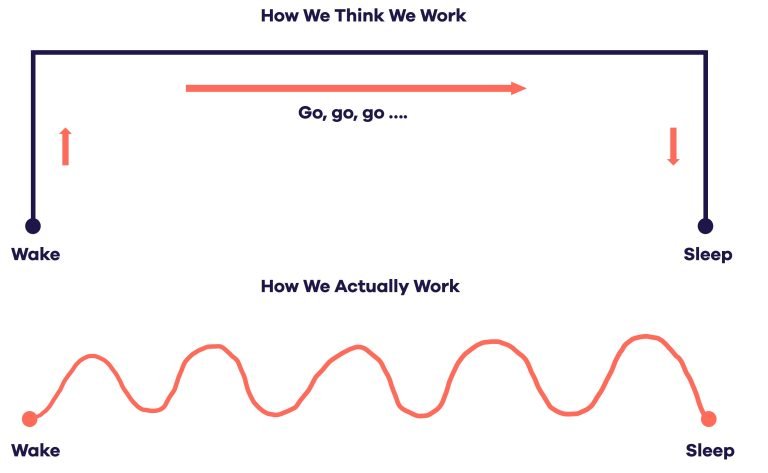
Ultradian rhythms occur throughout your day, manage your energy production and recovery cycles and have a powerful effect on your brain and body. When they are disrupted or ignored, they can affect your health, happiness, and general well-being. On paper, they look like this:

Ultradian performance: peaks and troughs
Your ultradian rhythms operate continually, day and night. While you’re sleeping, they mainly affect things like your REM patterns, so you don’t notice them much. But they have a far more tangible impact on how you feel during the day:
- As you start your day and get into a flow of activity and mental focus, your body and brain start burning through a significant amount of oxygen, glucose, and other fuels.
- Within 90 minutes, you reach the apex of your productivity, entering what’s known as an “ultradian performance peak.”
- After 90 minutes, your productivity and performance decline as your body enters what’s known as an “ultradian trough”.
- You start feeling tired, irritable, distracted, or hungry.
- You might feel the urge to go to the toilet or experience a sudden craving for sugar, carbs, caffeine, or (if you smoke) a cigarette.
- Rumination can creep in, or you may feel, “It’s only mid-morning, and I’m already exhausted. How am I going to make it through the day?”
This is the crucial bit
These are signs that your body is working exactly as it should be. These are your body’s “red flag” signals that it needs some downtime now or as soon as possible.
Your brain needs a break to sift through all the vast amounts of data you’ve taken in, order it, organise it, and store it. So it can produce those magical “aha” moments, creative insights, and brilliant solutions you wished you had more of. Oscillation determines whether you are a sparkling genius making great things happen or a grumpy mass of flesh parked on an office chair wishing you were elsewhere!
In short, even if you don’t care that much about your health and happiness if you care at all about your brain and your career, these signals your brain and body are sending you at this moment matter.
The moment you step away from external demands and oscillate, your body’s repair systems kick in, and this is called your “ultradian healing response.”
- Taking a break allows your blood sugar, hormones, and neurotransmitters to rebalance to complete important fix-it and filing tasks.
- Your frontline systems ramp up and rapidly return to total capacity for another 90 minutes.
What if you ignore the signals and skip that break?
Research shows that if you ignore your body’s signals and battle through these low-energy dips, your energy and focus will eventually crawl out of the ultradian trough, but not nearly as high as before. After a missed break, your next ultradian performance peak will be significantly lower than your previous one, which means you won’t get as much done, do it as well, and you won’t feel anywhere near as good.
For the next 90 minutes, your body and brain will keep slogging on, but at a reduced capacity.
Suppose you miss subsequent breaks as the day wears on.
In that case, you will feel a slump, and no amount of coffee or sugar will bring you back to optimum levels. Here’s the reality:
- Pushing through might seem like a good idea, but a lack of oscillation compromises focus and concentration. We struggle to think straight, so our error rate increases, our reading comprehension reduces, and our productivity plummets.
- Our peripheral vision narrows, so we miss things we’d typically notice.
- Our creativity declines, so we have more difficulty developing good ideas and solutions.
- Our physical coordination reduces, so we type more slowly, and our likelihood of stubbing a toe or spilling our coffee rises precipitously.
- Our cravings for sugar and refined carbs incline us to eat junk food that further contributes to inflammation and blood-sugar imbalances, reducing our energy and resilience and leaving us feeling like rubbish.
- Disruption of standard sleep patterns and decline in sleep quality reduce our effectiveness while undermining mood, immunity, and cognitive performance.
Ready to Build a More Resilient Team?
In other words, as we skip ultradian rhythm breaks, we get decreasing benefits and escalating risks on every level.
And the more ultradian rhythm breaks we skip, the worse the damage becomes. That’s why, by the end of the day, so many people are shadows of their former selves, tired, stressed and a bag of frayed nerves. It’s why so many people get home from a hard day’s work only to fall on the couch in a heap, eat a lot of unhealthy food, have multiple alcoholic drinks, or end up in arguments with their loved ones.
If we ignore our ultradian rhythms for days, weeks, or months at a time, the accumulated damage and distress become more tangible, producing a variety of nasty potential results that can cause serious conditions like heart disease, type 2 diabetes, autoimmune disorders, migraines, arthritis, depression, Alzheimer’s, and more.
It might seem tough to believe that these awful things could result from something as seemingly insignificant as some missed rest breaks. But when you think about it objectively, it makes sense that lack of oscillation breaks can significantly affect our health, sanity, and general well-being: Whenever you repeatedly overdrive and under-maintain any system, it tends to fail.
We’ve heard a great deal about the importance of sleep in the past few years. We now understand that our bodies accomplish most of their intensive repair and rebalancing work while we sleep. When it looks like we’re doing nothing, our bodies do some of the most important imaginable tasks.
Well, ultradian rhythm breaks are like “sleep snacks” not naps, per se, but similar in their potential to return a tired and depleted body to higher function.
The problem is that we’ve got some serious cultural programming to overcome here around rest, recovery, and self-care in general. We tend to think of taking a break as a sign of weakness, a surefire way to reduce productivity, and it’s guaranteed to cause stress as the work piles up.
Taking ultradian rhythm breaks is one of the best ways to improve our productivity, make more empowered choices, and access the inner strength we need to keep our healthy lives on track.
How Can You Start Listening to Your Ultradian Rhythm?
- Be on the lookout for signals that you need breaks. They include fatigue, brain fog, loss of focus and productivity, yawning, fidgeting, difficulty keeping your eyes open, irritation, hunger, thirst, clumsiness, increasing errors, and bathroom urges.
- Watch for ultradian troughs to strike mid-morning and midafternoon (within 90 minutes of starting work and 90 minutes after lunch).
- Stop what you are doing at the first signs and take a break: Twenty minutes is ideal, but any break (even five or ten minutes) is better than nothing. The longer and more chill your break is, the more repair and replenishing work your brain and body will do.
- Give your body and mind a chance to shift gears. If you’ve been sitting still, move. If you’ve been moving, sit still. If you’ve been focusing intensely, let your brain shut down.
- Engaging in simple manual tasks is okay (fill your stapler, empty the bin), but avoid any intensive demands or distractions, including electronics and digital media.
- Consider setting a timed alert that prompts you to assess your energy levels and focus every 90 minutes.
Ultradian Rhythm Break Activities
Here are some ideas to get you started:
- Go to the toilet (even if you don’t have to go).
Get a drink of water or tea and enjoy drinking it slowly. - Grab a healthy snack (avoid refined carbs and sugars) and eat it away from your desk while not doing anything productive, demanding, or attention-distracting.
- Get outside and walk.
- Close your eyes and do some Tactical Breaths.
- Walk around the building looking for things you never noticed before.
- Check in with a colleague or friend and engage in some much needed ACR skills.
- Do a mindless task, like refilling your stapler or cleaning your drawer.
- Grab the Good a few times and write it down!


